
- Product
-
Our Story
Why Choose Us?We are a national high-tech enterprise and a provincial "Specialized and Refined" SME, focusing on the R&D, production, and sales of PE protective film. As a leader in the industry, we are committed to serving global customers with innovative technology and have won wide recognition in the market.
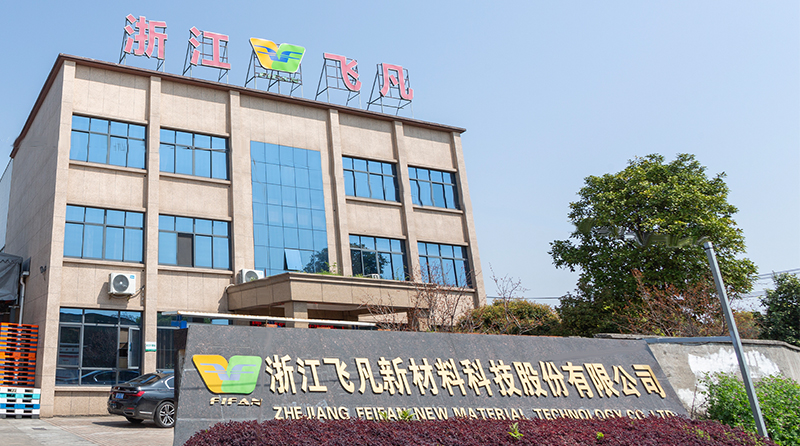 Coming From China, Marketing To The World.
 -
News
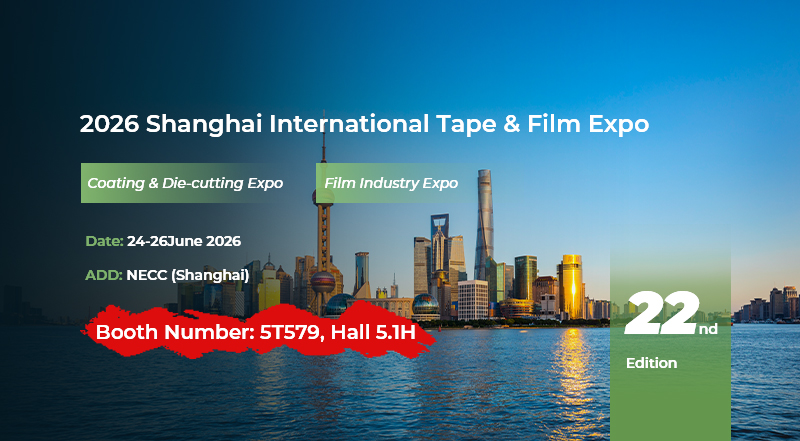 Feifan was invited to participate in the 2026 Shanghai International Tape and Film Exhibition
Dear Valued Customer / Partner, We are pleased to announce that our company will be exhibiting at APFE 2026 – the 22nd Shanghai International Adhesive Tape & Film Expo (Coating & Laminating E...
 English
 русский
 عربى
عربىConstruction Material PE Protective Film Suppliers: How to Choose One You Can Trust
Content
When a fabricator unloads a batch of PET decorative panels and finds a 300 mm scratch line across the first stack, the damage usually began weeks earlier under a protective film that could not handle transit. The same sequence repeats with stainless steel sheets, marble slabs, aluminum composite panels, and window frames: the rejection is discovered at fabrication, but the failure happened somewhere between the coating line and the production floor. That is why the true cost of a construction material PE protective film is not the price per square meter. It is the cost of the surface it fails to save.
Buyers who source films for building-material manufacturers need four answers before placing an order: Is the film matched to the substrate and the fabrication process? Will the adhesive release cleanly after weeks of contact? Does the supplier control every step that determines consistency? And can the supplier deliver at the volume and lead time the production schedule demands? The sections below turn those four questions into concrete evaluation points.
Match the film to the substrate and the fabrication process
Standard PE film can protect almost any smooth surface, but construction materials are not completely smooth, not perfectly flat, and not always stored indoors. A film that works on painted aluminum profiles can fail on a marble slab, on UV-coated wood veneer, or on color-coated steel that sits in an open yard for weeks. The first sign of a serious supplier is substrate-specific products rather than one film offered for every job.
| Substrate | Main risks during handling | Film priorities |
|---|---|---|
| Stainless steel sheets | Deep scratches from shearing, stamping, and folding | Heavy-duty anti-scratch film, medium-to-high tack |
| PET decorative panels | Dust pickup and electrostatic contamination | Antistatic film, low-to-medium tack |
| Marble and granite slabs | Cutting dust, edge chipping, adhesive residue | Conformable film, residue-free removal |
| Architectural aluminum panels | Forming stress, adhesive lifting at folded edges | High-tack film with balanced elongation |
| UV-coated wood veneer | Coating cracking, peel marks after removal | Low-tack film, clean release |
| Color-coated steel stored outdoors | UV yellowing, film brittleness after aging | UV-stabilized, anti-aging film |
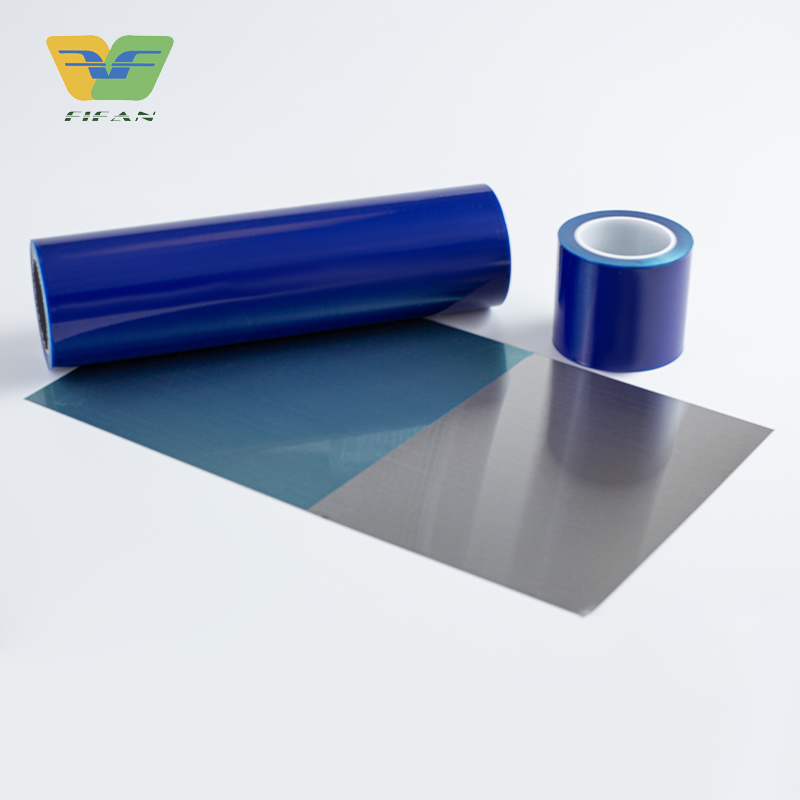
For stainless steel, fabrication usually involves shearing, stamping, and press braking. The film must survive the friction of the tooling, then strip off cleanly after the panel has sat in a workshop for several weeks. That duty calls for a heavy-duty anti-scratch PE protective film for stainless steel with medium-to-high tack and a carrier thick enough to absorb handling impact.
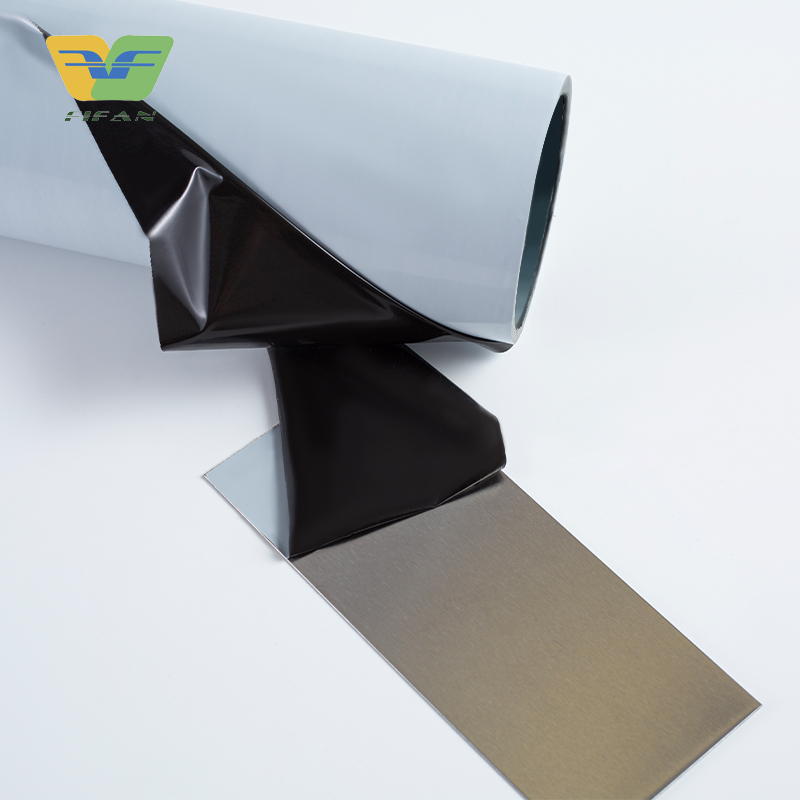 Custom Heavy-Duty Anti-Scratch PE Protective Film for Stainless Steel ODM/OEM SuZhejiang Feifan New Material Technology Co., Ltd. Is China Custom Heavy-Duty Anti-Scratch PE Protective Film for Stainless Steel ODM/OEM ...View Product →
Marble and granite change the analysis completely. The film must follow the micro-relief of the stone without tenting on the edges, and the adhesive has to release from a surface the customer cannot re-polish. A PE protective film for marble stone that is both conformable and residue-free is the safer starting point.
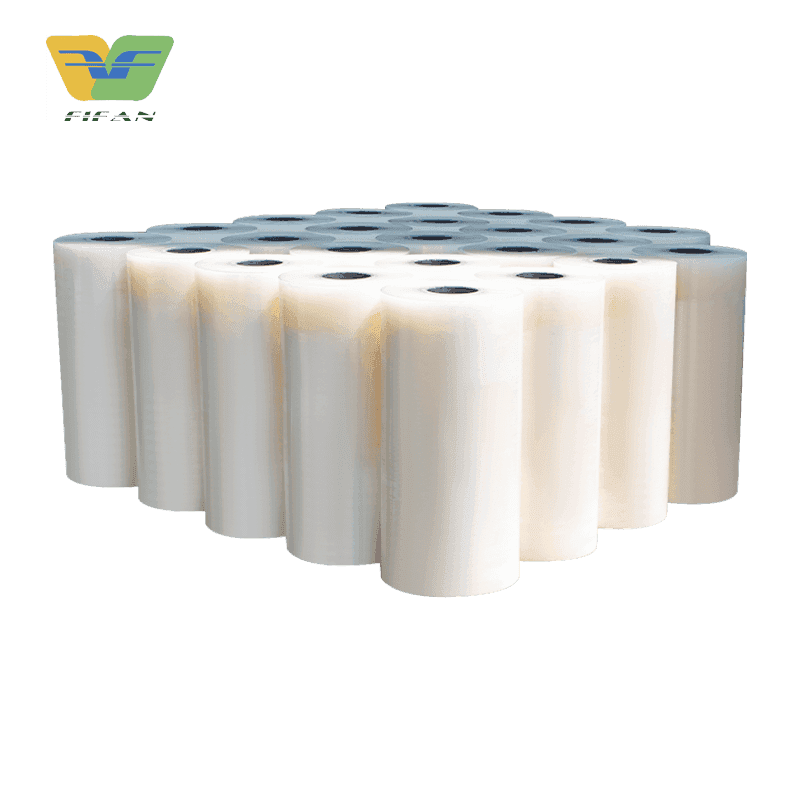 Custom PE Protective Film for Marble & Stone ODM/OEM Suppliers, Exporter, CompanZhejiang Feifan New Material Technology Co., Ltd. Is China Custom PE Protective Film for Marble & Stone ODM/OEM Suppliers, Exporter, Comp...View Product →
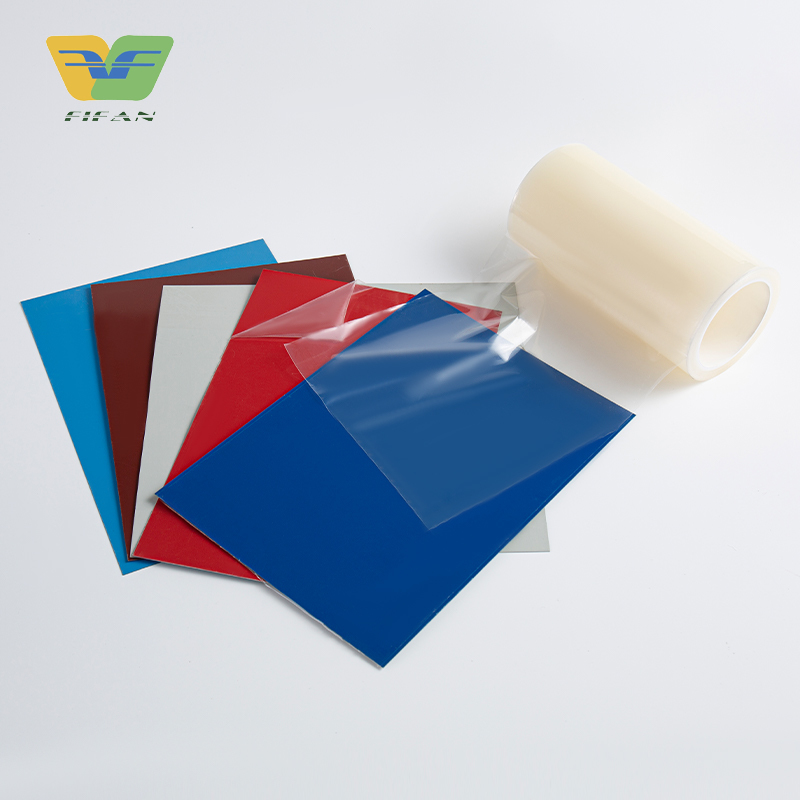
Color-coated steel produced for roofing and cladding is often palletized and stored outdoors before installation. Under direct sun, a film that is not UV-stabilized becomes brittle and can fracture on the first unrolling, scattering fragments across the painted surface. A UV-resistant anti-aging PE protective film for color-coated steel plates is the selection criterion, not an upgrade.
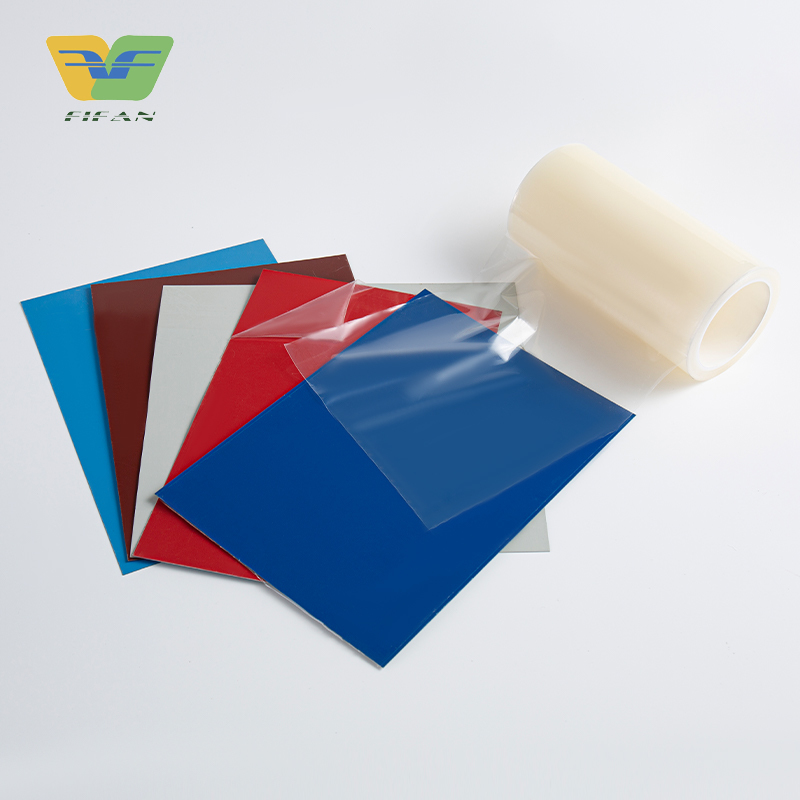 Custom UV-Resistant & Anti-Aging PE Protective Film for Color Coated Steel PlateZhejiang Feifan New Material Technology Co., Ltd. Is China Custom UV-Resistant & Anti-Aging PE Protective Film for Color Coated Steel Pla...View Product →
Adhesive choice determines whether removal is a formality or a rework cost
Most surface defects blamed on a bad film are adhesive failures. The polyethylene carrier rarely fails. Instead, the adhesive does not hold, it transfers onto the panel, or it becomes impossible to remove after aging. Three behaviors matter most: initial tack, peel-force stability over time, and response to temperature and UV.
Low-tack and high-tack: where each belongs
Peel adhesion, measured in newtons per 25 mm of width, is the standard way to classify protective film. Light protection on smooth, high-gloss surfaces typically runs from about 1 to 5 N/25 mm. Rough, embossed, or deeply formed parts usually need 8 to 20 N/25 mm so the film stays in place during cutting and bending. Higher tack raises residue risk, and the correct value depends on the substrate's surface energy and on how long the film will remain applied. Ask the supplier to recommend a tack level for your measured surface and dwell time. A supplier who requests substrate samples before quoting is evaluating the application, not just selling a stock item.
Self-adhesive and glueless options
Adhesive residue is not acceptable on mirror-finish metal, anodized profiles, or panels that will not be cleaned after the film is removed. Self-adhesive PE protective films create their own adhesion through surface contact, which is why the mechanism matters: the film must match the surface energy of the substrate. On smooth, clean metal sheets and plates, this approach eliminates residue risk at the system level. For a practical explanation, this guide to how self-adhesive PE protective film protects industrial surfaces covers the mechanism in detail.
UV and temperature effects on adhesive bonds
Construction materials rarely go straight from production to installation. Panels may wait for days in a yard, a warehouse, or a truck bay at 40-50 °C. Heat softens the adhesive; UV degrades the carrier. Either effect can turn a clean peel into a residue trail. If panels will be exposed to sun or heat before installation, request peel-force values after heat aging, not only the fresh values from the data sheet.
Supplier capabilities that prevent quality surprises
Full-process control: from resin to box
PE protective film quality is decided in four steps: film blowing, adhesive coating, slitting, and packaging. A supplier who buys ready-made film from one mill and coating from another cannot control thickness consistency, coating weight, or cross-web variation. In-house control allows the manufacturer to hold thickness within a tight band and to adjust the formulation when the substrate or process changes. When a procurement document asks for PE protective film, read it as a film whose resin, additive package, and adhesive are specified together. That level of integration comes from a manufacturer, not a converter.
Cleanroom coating and surface quality
High-gloss panels, glass, and mirror-finish stainless steel expose every trapped particle. A particle between film and substrate becomes a visible defect at the moment the film is removed. A Class 10,000 cleanroom for coating and slitting is a measurable indicator of surface-quality control, and it can be verified directly during a factory audit.
Quality inspection and traceability
Ask for the complete quality flow: incoming resin inspection, in-process monitoring, finished-goods inspection, and random outbound sampling. The part that protects you after delivery is batch traceability. If one roll creates a problem, a traceable supplier can identify the resin lot, the production date, and the coating run. Without traceability, a claim becomes an argument.
Capacity, lead time, and packaging
Protective film is a low-cost component with an outsized schedule impact; one late roll stops a line. Two capacity figures matter: annual film tonnage and annual protective film area, because together they show whether the supplier can absorb peak-season demand. Zhejiang Feifan New Material Technology, for example, reports an annual capacity of 8,000 tons of PE film and 50 million square meters of PE protective film, with blowing, coating, slitting, and packaging performed in-house. Delivery reliability also includes packaging: edge protection, clean interleaving, and labeling that keep the film usable the moment it reaches the line.
The two most expensive purchasing mistakes
The first mistake is buying on unit price without substrate testing. When applied to a panel that runs through a deeper-than-specified bend, a cheap film that fractures can reject 2% of a batch. The price difference between films is irrelevant next to that cost. The film must be tested on the actual substrate through the actual workflow: cutting, routing, bending, and removal after a realistic dwell period.
The second mistake is ignoring aging. A film that peels cleanly on day one can behave differently after 30 days at elevated temperature or after exposure to direct sunlight. Construction materials often carry protective film for weeks, so adhesive performance after aging belongs in the specification. Use a practical checklist for the sample test:
- Test the film on your fabrication steps, not on a clean flat coupon.
- Measure peel force at 7 days and again at 28-30 days; the gap is the real removal risk.
- Score and cut the film: does the edge fracture or tear cleanly?
- Leave a panel at 40-50 °C and check removal after it cools.
- Request the UV-aging report if panels will be stored outdoors.
- Ask whether thickness, tack, color, and printing can be adjusted to your line.
A wider view of what goes wrong in real purchases, from vague specifications to inconsistent batches, is covered in this guide to avoiding pitfalls when purchasing PE protective film. It is worth reading before locking in a supplier.
A practical supplier scorecard
| Criterion | What to verify | Weight |
|---|---|---|
| Process match | Sample test on your substrate and fabrication sequence | 30% |
| Manufacturing depth | In-house blowing, coating, slitting, packaging | 20% |
| Adhesive stability | Peel force after heat aging, residue test | 20% |
| Quality system | QC flow, cleanroom, traceability, certifications | 15% |
| Supply reliability | Capacity, lead time, packaging, communication | 15% |
The film is temporary by design, but its failures are permanent on the surface. For construction materials, choose a supplier that offers substrate-specific products, controls the steps from resin to finished roll, and tests with you under real conditions. Zhejiang Feifan New Material Technology has produced PE film and PE protective film since 2003, supplying appliance and new-energy vehicle manufacturers with the same surface-quality discipline required in building products. Its construction-material range covers the substrates described above, and its invitation to participate in the 2026 Shanghai International Tape and Film Expo reflects an active role in the industry. Whatever you source, start with a sample roll on your own line; a 30-minute test on real panels answers more than a month of data-sheet comparisons.
Your email address will not be published. Required fields are marked *
-
-
-
-
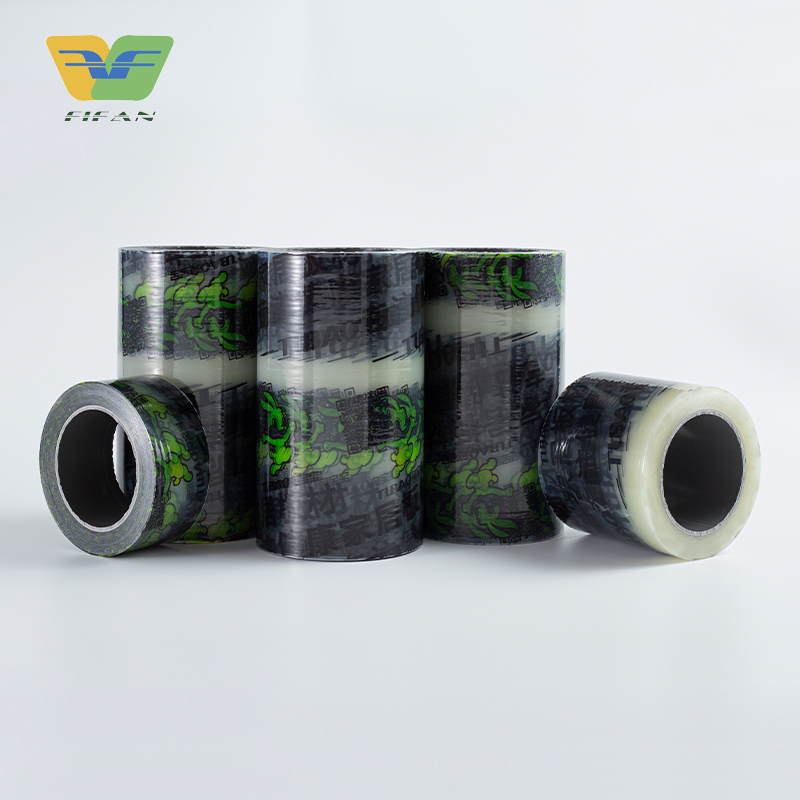
Construction Material PE Protective Film UV-Resistant & Anti-Aging PE Protective Film for Color Coated Steel Plates View More
-
-

Address: No. 1588 Gan Dong Road, Zhongguan Town, Deqing County, Huzhou City, Zhejiang Province, China
TEL: +86-572-8498038 / +86-15067289913
E-mail: [email protected]
Mobile
WhatsApp

Copyright © Zhejiang Feifan New Material Technology Co., Ltd. All Rights Reserved
